Introduction: This guide explains how to choose a soft PVC capping strip for a commercial sheet vinyl cove base system by matching the profile to the cove former, the sheet vinyl edge, and the wall substrate before ordering.
A capping strip works when it fits the cove former, covers the trimmed vinyl edge, and stays tight against the wall. On a commercial interior project, the cap is often ordered late and judged as soon as the floor-to-wall junction is finished. It arrives as a soft PVC profile, is cut and glued, and must sit flat against the wall without a gap beneath it or a bulge where the vinyl turns up. Most failures trace back to an earlier decision: the wrong profile, the wrong fixing method, or a product that was not designed for the cove base assembly. Select the strip by assembly fit, not by appearance, so the order matches the detail on the drawing.
Why a Sheet Vinyl Cove Base System Needs a Capping Strip Made for the Assembly
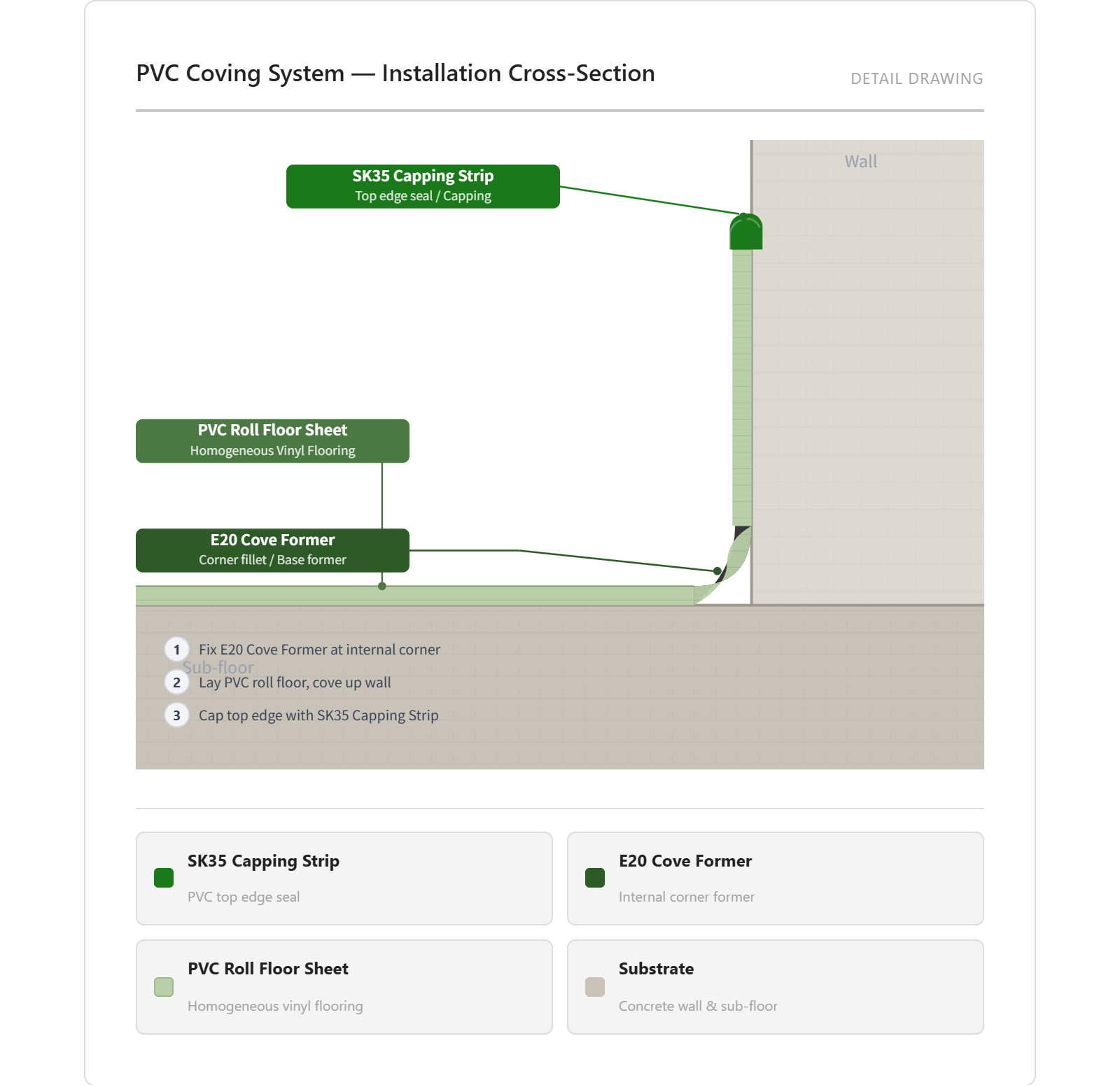
A sheet vinyl cove base is a three-part assembly: the vinyl carried up the wall, a cove former that shapes the floor-line radius, and a capping strip that closes the top edge. Pricing the cap as a stand-alone length of trim usually leads to a callback. The cap performs a mechanical function: it holds the trimmed vinyl edge flat against the wall, covers the cut, and forms a straight line at a consistent height. Its profile must belong to the same system as the former and the vinyl below it, just as a welding rod must match the sheet it seals. Project specifications reflect that relationship. Resilient wall base and accessories normally sit together in one section of the project manual, and CSI MasterFormat® gives them a shared classification instead of treating each item as generic trim. That grouping follows site practice: the inspector reads the floor-to-wall junction as one finished detail, not as three separate purchases. SectionFormat then sets out how accessory requirements are written into that section—height, material, fixing method, and approved product. When the former, vinyl, and cap are checked against the same drawing, the junction closes as drawn and no one has to re-cut profiles at the end of the schedule. There is also a cost argument. A cap that fits the assembly is installed once. A cap that almost fits gets trimmed, re-glued, or shimmed, and each correction consumes labour that was not priced. Matching the part to the assembly is cheaper than correcting it later.
How to Match the Capping Strip to the Cove Former and Sheet Vinyl Edge
Matching follows a fixed order. Start with the former because it sets the geometry. Then check the vinyl edge because it sets the depth the cap must cover. Finally, assess the wall surface and adhesive, which determine whether the cap stays tight after handover. Choosing by colour or height alone, without checking the former, is how mismatched profiles reach the site.
1. The Capping Strip Profile Must Follow the Cove Former Geometry
The cove former defines the radius at the bottom and the plane where the vinyl stops at the top. A capping strip made for that system has a back profile shaped to sit against the wall and a return deep enough to cover the trimmed vinyl edge without pinching it. Check the fit against the former you are installing, not a generic drawing, because radius, upstand, and trim point vary between systems. Soft PVC helps with minor wall variation because the strip follows the line of the former instead of fighting it. A profile that is too rigid transfers every hollow in the plaster to the visible edge, which shows on a long corridor run. Confirm that the return clears the vinyl thickness with the adhesive bed included; a cap that sits proud of the vinyl leaves a shadow line that pressure alone cannot close.
2. Adhesive Fixing and Wall Surface Condition Determine Whether the Cap Stays Tight
These strips are fixed with contact adhesive applied to both the wall and the back of the profile, left to flash off, then pressed firmly into place. The method creates a continuous bond line along the cap edge, but it depends on the substrate. The wall must be clean, dry, sound, and free of dust, release agents, and friable paint. On new plaster, confirm that the surface has cured and is not chalky. On refurbishment, remove old adhesive residue that could fail before the new bond does. Ambient temperature matters, and the strip should be acclimatized flat before cutting. Soft PVC conforms under hand pressure along a fair wall, but it cannot compensate for a crumbling substrate. Check the wall before applying adhesive.
How to Separate Soft PVC Capping Strip Options from Self-Adhesive or Rigid Trim
Three product families get confused at the ordering stage, and they are not interchangeable. A self-adhesive vinyl wall base is a peel-and-stick roll for retrofit work where no cove former is used; it has no place in a formed cove base detail because the vinyl edge remains exposed. A cove cap skirting product marketed as a peel-and-stick wall base belongs to that same self-adhesive family; it is not a substitute for a cap designed around a cove former. Wood skirting and aluminium or metal skirting are decorative or impact trims fixed mechanically, with a different junction geometry and no ability to follow a former radius. For formed interior sheet vinyl work, the correct family is a soft PVC capping strip fixed with contact adhesive. The CS/SK35 from UNITECH FLOOR is a soft PVC profile in 35 mm and 40 mm heights, made for interior sheet vinyl cove base systems and used with a cove former. The SK35 TDS is available on request for submittal data. The height comes from the project drawing or material schedule—confirm that number before ordering. Packaging length, standard colours, MOQ, lead time, price, and certification details are confirmed with the supplier when you enquire. A sample of the profile against your own former is the fastest way to settle fit before a bulk order.
Conclusion
Choosing a capping strip comes down to three checks in order: does the profile follow the cove former, does it cover the vinyl edge cleanly, and will the wall and contact adhesive hold it tight? Once those are settled, the remaining decisions are commercial: height against the drawing, colour against the approved finish, and supply against the schedule. Soft PVC, contact adhesive fixing, and former compatibility rule out self-adhesive, wood, and metal options in one pass. If you are pricing a commercial interior package, request the SK35 TDS, ask for a profile sample to test against your former, and confirm MOQ, standard colours, and lead time with the supplier before the submittal goes in.
FAQ
Q: What is the role of a PVC capping strip in a sheet vinyl cove base system?
A: It closes the top edge of the cove base. The sheet vinyl is carried up the wall over a cove former, trimmed level, and the capping strip is glued over the cut edge. The cap holds the vinyl flat, hides the cut, and gives the wall a straight finished line. It is a functional part of the junction, not a decorative add-on, so its profile must match the former and the vinyl thickness.
Q: How should a cove former capping strip match the sheet vinyl edge?
A: The return on the back of the profile must cover the trimmed vinyl edge with the adhesive bed included, so the strip sits flush against the wall without pinching the vinyl or standing proud of it. Check the fit against the actual former you are installing because radius and upstand differ between systems. Cut a short test length before running the full wall.
Q: Does the CS/SK35 capping strip use contact adhesive rather than self-adhesive backing?
A: Yes. The CS/SK35 is fixed with contact adhesive applied to both the wall and the back of the profile, then pressed into place after the adhesive has flashed off. It has no self-adhesive backing. It is a soft PVC strip for interior sheet vinyl cove base systems, supplied in 35 mm and 40 mm heights for use with a cove former.
Sources / References
MasterFormat® - Construction Specifications Institute
SectionFormat/PageFormat - Construction Specifications Institute
Home - FCICA - Flooring Contractors Association