


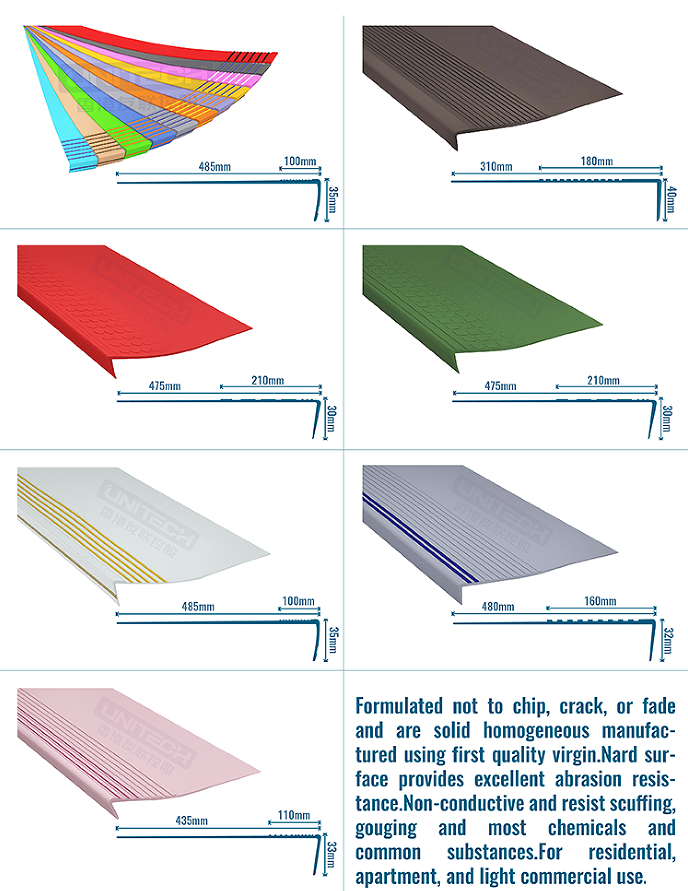
The 310 mm PVC stair tread is a solid PVC cover laid over an existing step to give it a clean, hard-wearing walking surface. At 310 mm deep it covers the full going of most commercial and institutional stairs, so there is no joint running across the middle of the step where a heel or a trolley wheel can catch. Standard pieces are 1200 mm and 1500 mm long, and other lengths are made to the dimensions you send us.
Projects specify it for two reasons. The first is repair: a flight whose steps are chipped, worn through at the nose or simply dated can be brought back into service a step at a time instead of being demolished and re-cast. The second is design: the tread is produced in the same PVC family and in colours chosen to sit beside our sheet flooring, so a stairwell can carry the colour scheme of the corridor below it instead of breaking into a different material at the first step.
As part of our wholesale stair treads range it arrives cut square and finished on the face, ready to be trimmed to the width of the flight on site. It is almost always specified together with a nosing at the front edge, which takes the impact and closes the joint between the tread and the step beneath.

Treads are made from a solid homogeneous PVC vinyl compound, produced from first-quality virgin material and coloured through the full thickness of the piece. There is no printed film or laminated wear layer sitting on top, so a scuff at the nose or a cut from a site tool stays a local mark instead of turning into a pale patch that spreads as the surface wears.
The compound is formulated not to chip, crack or fade, and it is non-conductive, which matters on stairs beside electrical risers, plant rooms and service corridors. It is non-toxic and RoHS-compliant. An antibacterial additive is part of the formulation, which helps in schools, clinics and public buildings — it supports a routine cleaning regime, it does not replace one.
The face carries a fine matte texture rather than a high gloss. That texture is where the abrasion resistance underfoot comes from, and it is also what keeps a stair presentable: matte PVC hides heel marks, trolley scuffs and the dull patches that appear where everyone turns. A glossier face shows every one of them.
| Thickness | 4 mm |
| Tread depth | 310 mm |
| Standard lengths | 1200 mm and 1500 mm |
| Custom lengths | Made to project dimensions |
| Hardness (ASTM D2240) | 80 |
| Abrasion resistance (ASTM D3389) | 0.06 |
| Tensile strength (ASTM D638) | 2240 lbf/in2 |
| Elongation (ASTM D638) | 210% |
| Ageing test (100 °C, 168 hours) | 8.5% tensile difference; 1.3% cementation index |
| Compound | Solid homogeneous PVC vinyl, virgin first-grade |
| Colour | Through the full thickness |
| Surface | Fine matte texture |
| Behaviour | Non-conductive; resists scuffing, gouging and most common chemicals |
| Edge option | aluminum stair nosing profile |
The front edge of a step is where a stair fails first, so the tread and the edge are specified as a matched pair. The profile covers the junction between tread and step, protects the leading edge from being kicked up or worn through, and gives the flight a straight, defined line. A nosing with a ribbed top surface and a curved front lip wraps over the nose rather than sitting on top of it, which keeps the joint tight on a refurbishment where the old nose has been trimmed back.
A vinyl stair nosing produced from the same compound and colour reference as the tread lets the edge disappear into the step. On a new build the nosing is set before the tread is finally bedded, so the two line up in one operation; on a retrofit the existing nose is cut back and the profile covers the cut. Because both parts come from the same range and the same colour, the assembly reads as one surface rather than as a floor with a strip bolted to the end of it — which is what specifiers ask for when the stair is visible from the lobby.
Where a tread meets a different material at a landing, or where the stair is open on one side, the same profile family closes the detail without a bespoke piece.


A vinyl stair tread is judged over years rather than weeks: what matters is whether the surface still grips in year five, whether the nose is still square, and whether a cleaning team can bring the colour back after a bad week. The compound resists abrasion and holds its dimensions under continuous load, so the piece stays flat on the step instead of curling at the edges and rocking underfoot.
Grip comes from the texture of the material itself rather than from a coating applied on top, so it is not lost as the finish wears. Day-to-day cleaning is damp mopping with a neutral detergent — no stripping, sealing or buffing, no drying time and no solvent smell in an occupied building. That is the operational point: a stair that is cleaned in one pass can be handed back sooner, and the surface carries no maintenance programme of its own.
Set against re-casting or re-tiling a flight, the calculation runs per step rather than per stairwell: the material, the adhesive and one visit from a fitter, with the stair back in use at the end of it.
Schools, kindergartens, clinics and hospital wings put the same demand on a stair: the people using it are not always watching their feet. Children run down flights, patients arrive on frames and in wheelchairs, visitors read signs instead of steps. A tread with a defined, textured walking surface and an anti slip stair nosing at every nose gives the whole flight one consistent grip line, so the step feels the same at the top of the building as at the bottom.
Hygiene matters as much as grip. Stairs in these buildings are cleaned daily with the same disinfectants used on the flooring, and the compound resists the common substances a cleaning team reaches for, so the stair does not stain or dull ahead of the floor beside it. The matte face hides what a busy school leaves behind and mops back to colour.
Colour does a second job here. On a long hospital corridor stair, a tread in a contrasting tone at the first and last steps helps people read the change of level; in a primary school the same detail marks the last step before a doorway. Because pieces are cut to the flight, a stair that was built slightly out of square still ends with an even line of nosings rather than a ragged edge.
Orders are built from a flight schedule rather than from a catalogue number: send the number of steps, the width and length of each, the colour reference and the edge profile you want, and we will confirm what is standard and what has to be made. We supply wholesale stair treads for large-scale projects as well as single-flight replacements, and a multi-block order is scheduled together so the colour stays consistent from the first block to the last.
Standard lengths come out of regular production; custom lengths and special colours are made to order, so confirm availability and the documents you need for your file with your sales contact before the programme is fixed. Payment is by TT or LC. Typical lead time is 7-15 days. Treads are bundled, wrapped and strapped for container loading, with the nosings packed separately so the profiles are not crushed in transit.

These wholesale stair treads are made for commercial and institutional buildings where stair safety and long service life come first. Facility managers, architects and builders use the vinyl tread to give high-traffic stairs a robust, slip-resistant walking surface that reduces fall risk, and pair it with PVC stair nosing for full edge protection and a consistent look across each flight. The range is aimed at public-access environments where stair assemblies have to line up with the safety and compliance requirements of the project, so it is worth confirming the specific standards and documentation your authority asks for before you specify.
Integrated tread and vinyl nosing assemblies are used across transport hubs, healthcare facilities, educational institutions and commercial office buildings. The surfaces are durable and corrosion resistant, resisting scuffing and chemical exposure so stair safety protocols hold up in daily use, and aluminium nosing variants add structural resilience where mechanical impact is frequent, such as industrial settings. For facility managers the result is fewer operational risks and less maintenance intervention, which supports long-term asset preservation and occupant safety targets.
Shanghai Unitech Plastic Co., Ltd. has been supplying flooring and the products that finish an installation since 2000, working as a factory-based exporter from Baoshan District, Shanghai. Our 30-strong team runs production and export side by side: total monthly output exceeds 200 tons, and our quality management system is certified to ISO9001:2008. Buyers across Southeast Asia, the Middle East, South America and North America source a complete package from us — we support OEM production, handle one-stop export, and work to a typical dispatch window of 7–15 days.
Standard pieces are 1200 × 310 × 4 mm and 1500 × 310 × 4 mm. Where a flight is wider than a standard length, the vinyl stair tread can be made to the length you measure, and a landing can be supplied as one piece. Colours are matched to the project scheme rather than picked from a fixed card, so tell us the flooring you are working to and we will confirm the closest available.
The compound is non-toxic PVC and meets RoHS requirements, and the tread is non-conductive. That covers the wording most public-sector specifications ask to see. Send us the compliance clause your tender uses and we will tell you which documents we can provide for the file, and say plainly where a value is not something we test.
The tread is normally finished with a pvc stair nosing in a matching tone, so the edge reads as part of the step, or in a contrasting tone where the nose needs to stand out. Choose the profile at the same time as the tread so both come from one colour reference — fitting an edge from another source is how stairs end up with a visible mismatch on every step.
Each step is measured, cut and bonded on its own, so the work moves up the flight and there is no wet trade setting the whole stair at once. Keep the flight closed until the adhesive has cured; the cure window depends on the adhesive and the conditions in the building, and our team will confirm it for your site.
It lifts the finished surface by its own thickness. On most flights that is absorbed at the bottom and top steps, but check the first riser at floor level and any door threshold at the head of the stair before the order is cut. If the change matters, tell us and we will look at the detail with you.
Damp mopping with a neutral detergent is enough for everyday cleaning, and the matte face comes back to colour without a sealer or a polish. Stronger disinfectants used on the surrounding floor are normally fine; spot-test on an offcut first if the product is new to your cleaning team.
Solid PVC does not absorb water and the surface handles routine wet cleaning. Poolside and shower areas have their own slip requirements, though, so tell us where the stair is and we will confirm whether this tread and edge combination is right, or whether a different surface is the better answer.
